Most tools that promise to help us feel more focused, grounded, or organized begin with an instruction: open the app, start the session, set aside the time.
That structure makes sense on paper. It also assumes that the moment you most need support is the moment you have enough distance from the day to go looking for it.
Usually, you do not.
The useful object is often the one already within reach. It sits on your desk, lives in your pocket, or rests against your skin. It asks very little before it helps you do something you meant to do anyway.
This idea sits at the center of Aurelae's approach to functional jewelry. Aurelae begins with a different design question: how can an object be beautiful enough to wear daily and carry a real, repeatable use, without asking its wearer to become a different person first?
The problem with objects you have to remember
Many wellbeing tools are thoughtful and well designed. Their limitation is practical. They live somewhere else.
An app can offer structure, guidance, and data. A journal can create space for reflection. A meditation cushion can mark the beginning of a ritual. Each has value. Yet a crowded day is full of gaps too small for a formal practice: the lift before a presentation, the minutes between calls, the walk from the car, the instant after a difficult conversation.
Those are the moments that shape how the day feels. They are also the moments when a tool needs to be close enough to use almost without negotiation.
What you wear has a different relationship with time. You do not have to retrieve it or charge it. It is already part of the scene. That proximity changes the threshold for use.
A necklace can be touched while you think. A ring can be turned in a waiting room. A bracelet can become a small cue before you answer. None of these actions needs to become a performance. The design succeeds when it fits quietly inside real behavior.
Beauty is part of the function
There is a tendency to treat aesthetics as the final layer, added once the useful work is finished. That misses something important.
We form relationships with objects long before we assess their specifications. We notice proportion. Weight. Surface. The sensation of a clasp between the fingers. Whether an item belongs with the clothes we already wear, or feels like something reserved for a version of ourselves with more time and better habits.
When an object is beautiful enough to wear every day, it earns proximity. And proximity makes use more likely.
That is why the tension between aesthetics and function should stay visible throughout the design process. A functional object that looks clinical may be left in a drawer. A beautiful object with no meaningful role may be admired, then forgotten. The work is to make both sides sharpen each other.
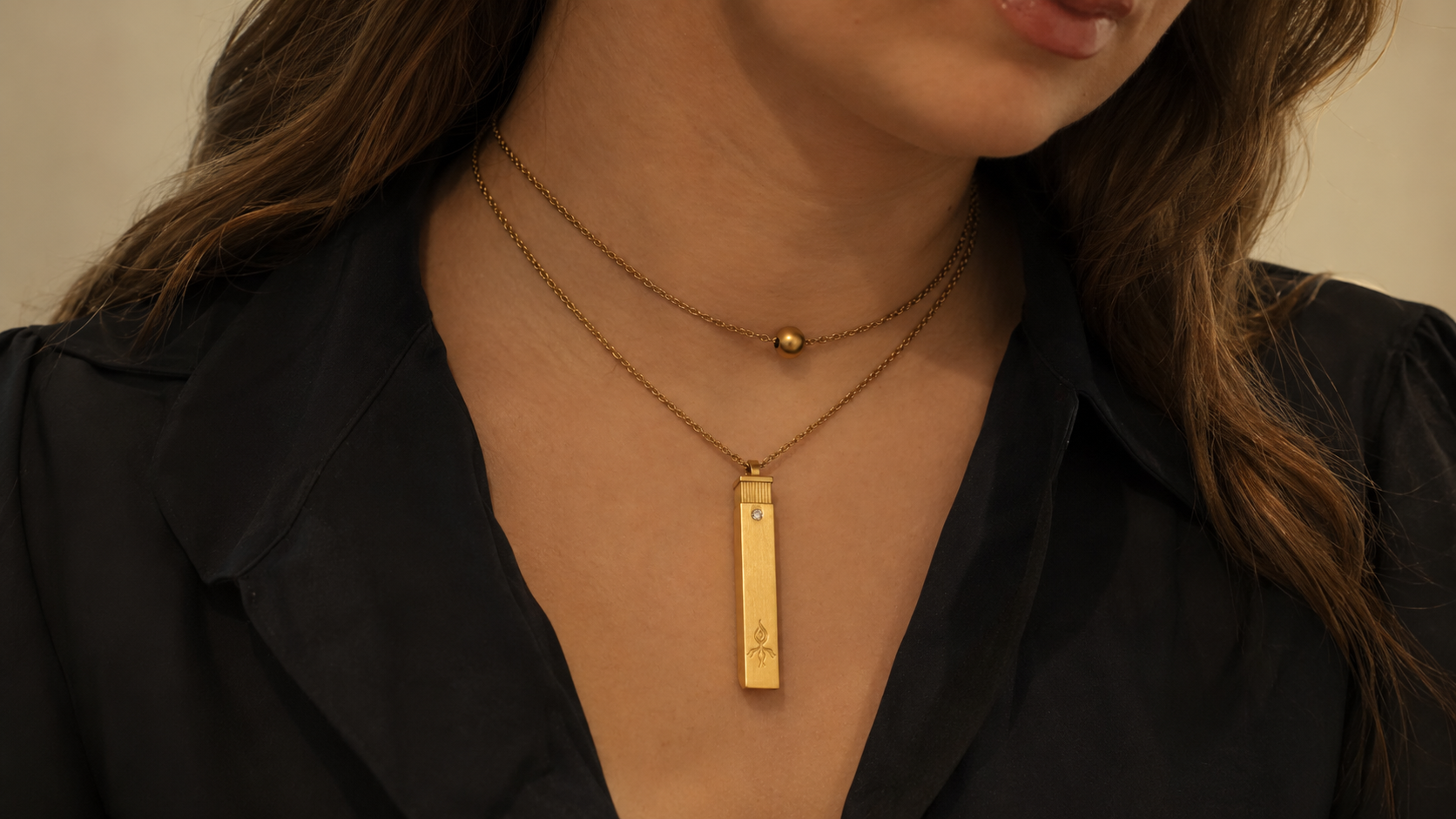
For Luma and Eira, the pendant had to read as jewelry first, in the way it sits, catches light, and works with an existing wardrobe. The function then had to be simple enough to remember under pressure: bring it to the lips and exhale slowly through its internal channel. The channel creates gentle resistance, giving the out-breath a physical form and a clear endpoint.
Every detail has to serve the same intention. The proportions need to feel considered, rather than technical. The material needs to hold up to daily wear. The surface needs to invite touch. Even the chain matters, because the object cannot become part of someone's day if it never feels comfortable enough to put on.
A cue is more useful than a command
Good design rarely asks for a lecture. It suggests an action.
A door handle tells your hand what to do. A well-made pen makes you want to write. A tactile surface can invite a pause before you are conscious of choosing one. These small exchanges between person and object are easy to overlook because they happen so quickly.
Functional jewelry works through the same principle. It places a cue in the environment of your own body. The cue can be visual, tactile, or practical. You see the pendant when you get dressed. You feel it when your attention drifts. You use it when you want a slower exhale.
That is a different proposition from tracking every feeling or outsourcing awareness to a screen. The object remains passive until you decide to use it. It leaves the decision with the wearer, without notifications, streaks, or another metric to maintain.
Some days, it may simply be jewelry. On other days, it can be the prompt that helps you pause before you react. Both uses are valid. The relationship should be yours to set.
Designing for a life that is already full
Aurelae is made for people with demanding calendars, strong ambitions, and little patience for objects that create more work. That does not mean designing for relentless productivity. It means respecting the reality that clarity often has to be regained in motion.
The best everyday tools do not ask you to escape your life in order to use them. They travel with it.
A pendant will not resolve a hard decision. It will not make a full inbox disappear. What it can offer is a small, available action when the pace begins to outrun your attention. That can be enough to change the quality of the next minute.
For us, that is the standard. Create objects you want to wear before you need them, then make their purpose clear enough that you reach for them when you do.